Best inflatable tents
- Updated October 30, 2026
- 2 models compared
- 4 min read

What are the best inflatable tents?
Choosing a tent is never easy, as several factors come into play: how many seasons, the type of tent and so on.
We also often want to make travelling and setting up camp less of a hassle. Imagine you’re with your family, it’s getting dark and the tent isn’t up yet. Just connect your pump and it’ll be ready in under 10 minutes. That’s why inflatable tents are perfect: they take a lot of worry out of camping.
Comparison of the best inflatable tents of 2026
| Product | Stands out for | Price |
|---|---|---|
|
Vango Odyssey Air
Best rated
|
Quality | See price |
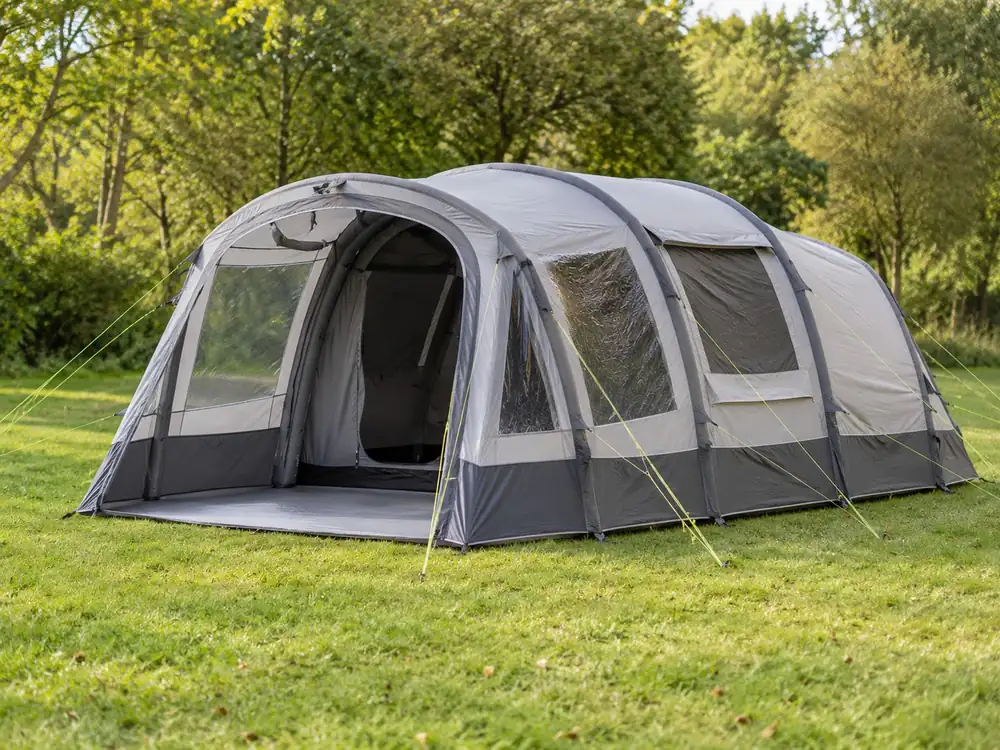
Portal Alfa 4 inflatable tent
Our favourite
|
Space | See price |
Best deals from the Amazon range
Which one should you buy? The top 2
1. Vango Odyssey Air
The good
Quality: very good materials
3 seasons.
Accessories: comes with a pump with 3 nozzles that also fit airbeds. The pump deflates too.
Space: you can change the layout inside, with one open space or separate bedrooms.
Worth knowing
Price: a bit expensive, but worth it for its quality and durability.
Our favourite 2. Portal Alfa 4 inflatable tent
The good
Space: very roomy inside. Keeps out the light at night.
Materials: high-quality materials.
Inflation: quick inflation system.
Accessories: comes with a pump.
Worth knowing
Price: a bit expensive.
Inflatable tents: reviews and features
The key feature of these tents is that the poles are replaced by inflatable beams, making the structure stronger and the tent quicker to pitch.
We generally like inflatable tents for their high quality, but as always, there are a few things to be clear about before buying. Unlike traditional tents, they have no poles, so always have a puncture repair kit to hand (usually included with the tent) to fix any air leak.
If you think about it, this is no worse than with a normal tent: fixing a broken pole with tape is likely to take you longer than repairing a small puncture.
In our opinion, inflatable tents are perfect for large groups or families touring campsites by car. The downside is that they’re quite expensive and heavy, and you always need to bring a pump.
We recommend buying one.
Frequently asked questions
It replaces poles with air beams. You inflate it with a hand or electric pump to the pressure the manufacturer specifies and it stands up on its own. Pitching usually takes 5–15 minutes in practice.
Very fast pitching, fewer loose parts, good stability when properly tensioned and more convenient for families. On the other hand, it usually weighs more and is bulkier when packed, and the price is higher.
With guy lines properly set, they handle gusts very well because the air absorbs some of the load. If there’s a puncture, the beam can usually be repaired or replaced (inner bladder).
It depends on the system (5–8 PSI is common, for example), but always follow the manufacturer’s range. Don’t over-inflate; check with a pump with a pressure gauge.
Air expands in the heat and contracts in the cold. Check the pressure if the temperature changes a lot. Avoid leaving it for hours in full sun without ventilation.
Yes. Most come with patch kits; you can also replace the inner bladder if the damage is serious. Check the valves and seals regularly.
A double-action hand pump works well; for large tents an electric pump with automatic pressure cut-off is handy. Always bring a backup pump.
Generally yes (more fabric and structure). For car camping it’s not a problem; for trekking they aren’t recommended.
As a guide, flysheet 2,000–3,000 mm and groundsheet 3,000–5,000 mm, with sealed seams and a true double skin. A bathtub groundsheet on family models.
They usually come in large wheeled bags (especially family models). Check your car boot and the total weight before buying.
Most are 3-season. For harsh winters (wind, snow), look for reinforced models and check their wind resistance and structure.
Rinse off sand and salt, dry it completely before storing, check the valves and bladders once a season, and don’t store it compressed for months.
A pressure gauge, an electric pump with cut-off, a repair kit, quality pegs, reflective guy lines, a footprint and a carpet for the living area.
Ideally the manufacturer offers spare bladders and valves, reinforced seams and a 2-year guarantee (the legal minimum in the EU for manufacturing defects).
Other types you may like
 Best luxury tents
 Best Large Camping Tents of 2026
 Best cheap tents of 2026
 Best camping tents
 Best family tents of 2026
 Best tents for kids
 Best ridge tents
 Best dome tents of 2026
 Best tipi tents
 Best 2 Seconds pop-up tents
 Best tunnel tents
 Best camping gazebos
We choose products independently. If you buy through our links, Amazon pays us a small commission at no extra cost to you.