Best tents for kids
- Updated October 30, 2026
- 5 models compared
- 7 min read

What is the best tent for kids?
Children love making up their own stories while they play. And what better place to do it than a kids’ tent shaped like a castle or a tipi?
Whether it’s an indoor or an outdoor tent, children will have a whale of a time and let their imagination run wild. It’s also a way to introduce them, little by little, to the wonderful hobby (or rather way of life) that is camping.
The market offers countless kids’ tents in all sorts of qualities, materials and shapes. On this page we show you the ones that we and our readers consider the best tents for kids on the market, for their quality, design and durability and, of course, because they’re the most fun for boys and girls.
If you’re looking for the perfect present for a boy or girl, one that lets them explore and share with their friends or siblings, you’ve come to the right place.
Let’s get started!
Best deals on kids’ tents on Amazon
Comparison of the best tents for boys and girls
| Product | Stands out for | Price |
|---|---|---|
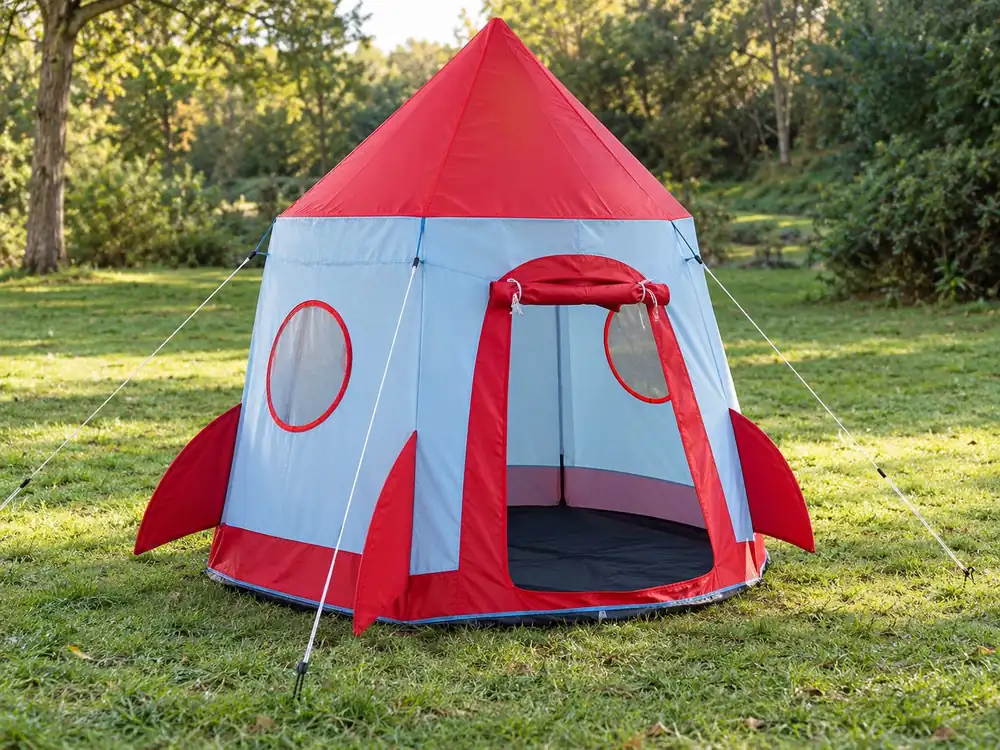
SONGMICS Kids' Rocket Tent
Our favourite
|
Good quality | See price |
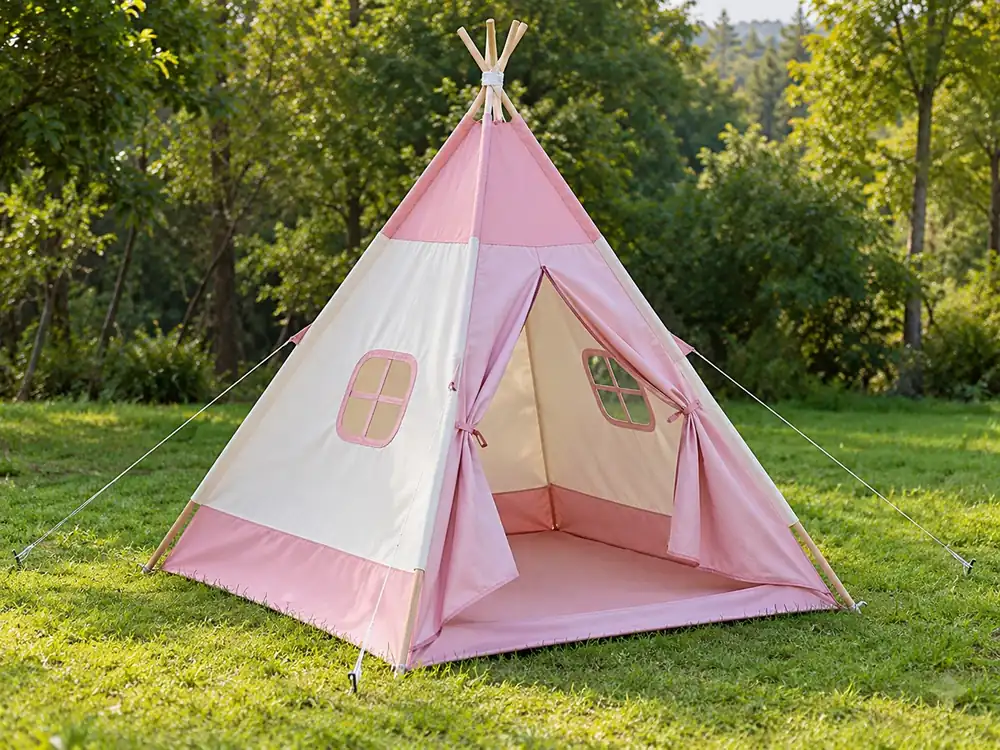
SONGMICS Kids' Tent Pink
Cheapest
|
Good quality | See price |

Tiny Land Kids' Tipi
Best rated
|
Materials | See price |
| Materials | See price | |
| Materials | See price |
Which one should you buy? Top 5 of 2026
Our favourite 1. SONGMICS Kids' Rocket Tent
The good
Good quality: very good-quality materials.
Capacity: fits 2 to 3 children.
Protection: meets the necessary safety standards.
Pitching: easy to put up and take down.
Worth knowing
Floor: the floor could be padded.
Cheapest 2. SONGMICS Kids' Tent Pink
The good
Good quality: very good-quality materials.
Capacity: fits 2 to 3 children.
Protection: meets the necessary safety standards.
Pitching: easy to put up and take down.
Worth knowing
Floor: the floor could be padded.
Best rated 3. Tiny Land Kids' Tipi
The good
Materials: very good quality, cotton and pine wood.
Design: we love the tipi shape.
The base: padded, non-slip mat.
Lights: fairy lights included with the tent.
Worth knowing
Price: a bit expensive.
4. NARMAY Play Tent Space World
The good
Materials: very good quality.
Design: shaped like a space capsule with a tunnel.
The base: fully waterproof.
Multi-purpose: you can use it indoors and outdoors, unlike the previous ones.
Worth knowing
As with the first tent in our selection, you need to tension the guy lines properly to keep it stable.
5. Tiny Land Princess Tent
The good
Materials: very good quality.
Design: a very pretty princess design.
Pitching: very easy to put up and take down. Storage bag included.
Nice touch: a magic wand comes with the tent.
Worth knowing
The colours may fade over time if it’s left in the sun.
What should you consider before buying?
Choosing a kids’ tent isn’t straightforward, given how many models there are on the market. There are several things to bear in mind. On this page we’ve shown you the kids’ tents we like best and recommend for the quality of their materials, their looks and, above all, children’s safety: a poor-quality tent with faulty materials can cause harm.
Here are a few tips on what to look for when buying or giving a kids’ tent.
Price
The good thing about kids’ tents is that they aren’t very expensive. You can find a good-quality one for between 25 and 100 euros. In our opinion, anything under €25 isn’t worth it.
In the comparison above, we show you the cheapest one that still offers perfect quality for little ones, the one best rated by Amazon buyers and our readers, and our favourite.
Space
This one’s simple: think about how many children will use the tent. Bear in mind that they grow fast, so it’s worth buying one a bit bigger so it gets more use.
Materials
The materials should be good-quality fabrics such as cotton, pine wood or polyester. The base should protect against damp and cold, be padded (you can fix this by putting foam underneath) and, very importantly, have a non-slip surface to prevent slips.
Openings
With kids’ tents, openings to control the temperature aren’t usually a priority, but do make sure the main entrance is wide to keep the heat down in summer.
Benefits of kids’ play tents
Play isn’t just a way to keep children busy: it also helps them develop skills, learn and understand the world around them. So the main job for parents is to find the best toys and accessories.
A kids’ tent is a play space that lets little ones explore their creativity through role play and imitation, or get in touch with nature and the outdoors. It also fuels their imagination. Its benefits include developing children’s imagination, curiosity, motor and cognitive skills and independence, and stimulating their physical, social and mental abilities.
If you set the tent up as a play area, toys will no longer be scattered all over the house but kept in that corner. Having a space of their own also encourages social relationships and a sense of responsibility.
Buying or giving a kids’ tent has nothing but advantages.
Frequently asked questions
A play tent (indoors or in the garden) puts lightness and design first; it isn’t waterproof or wind-resistant. A kids’ camping tent uses technical fabrics, a flysheet, a bathtub groundsheet and sturdier poles: it’s made for sleeping outdoors safely.
As a guide: 3–4 years for play tents, with adult supervision. For camping and sleeping out, 5–6+ years is better, with children’s sleeping bags and mats and always an adult nearby.
A usable interior of 120–140 cm wide, 200–220 cm long and 100–120 cm high. Leave room for children’s mats (≈45–50 cm) and rucksacks.
Ripstop polyester with fire-retardant treatment and taped seams on camping models. For play tents, look for child-safety certifications and non-toxic dyes.
Flysheet ≥2,000–3,000 mm and groundsheet ≥3,000–5,000 mm, plus a proper double skin and sealed seams. Add a footprint to protect the groundsheet and improve waterproofing.
Aluminium is lighter and stronger. Fibreglass keeps the price down but wears out sooner. For real camping, aluminium is better; for indoor play, a flexible or tunnel frame is fine.
Ventilate with high and low vents, leave the mesh panels slightly open and don’t cook inside. A separate flysheet helps a lot.
Yes: they go up fast and are handy for car camping. Check the weight, the pump and the spare valve parts.
A children’s sleeping bag (right length and temperature rating), a short mat or self-inflating one, a head torch or torch, a pocket organiser, a play mat or rug and a ground protector.
For daytime play, look for UPF 50+ and mesh windows. Remember that play tents are no substitute for a camping tent for sleeping outdoors.
Clean it with mild soap, dry it completely before packing it away and avoid prolonged direct sunlight (UV). Well looked after, a kids’ camping tent lasts several seasons.
Always adult supervision, stoves outside the inner tent, take care with cables and LEDs, pegs firmly anchored and check the weather forecast.
Other types of tent you may like
 Best luxury tents
 Best Large Camping Tents of 2026
 Best cheap tents of 2026
 Best camping tents
 Best family tents of 2026
 Best ridge tents
 Best dome tents of 2026
 Best tipi tents
 Best 2 Seconds pop-up tents
 Best tunnel tents
 Best camping gazebos
 Best inflatable tents
We choose products independently. If you buy through our links, Amazon pays us a small commission at no extra cost to you.