Best ridge tents
- Updated November 3, 2026
- 2 models compared
- 6 min read

What are the best ridge tents?
When we talk about tents, the first image that comes to mind is that triangular shape typical of ridge (A-frame) tents , thanks to how often they’ve appeared in films and especially cartoons.
Nowadays this type of tent is used less and less because of its rather dated design. They have largely been replaced by dome tents, which are much more comfortable in terms of access (no central pole) and capacity.
These tents are easy to pitch and take down, but they have the drawback of being very heavy because of their metal frame. They also have plenty of room in the middle, but lose space at the sides because of their shape. That’s why you see fewer and fewer of them, but if you’re nostalgic or a fan of this type of tent, here are the best ones so you can start enjoying yours as soon as possible without going mad searching.
Let’s get started!
Comparison of the best of 2026
| Product | Stands out for | Price |
|---|---|---|
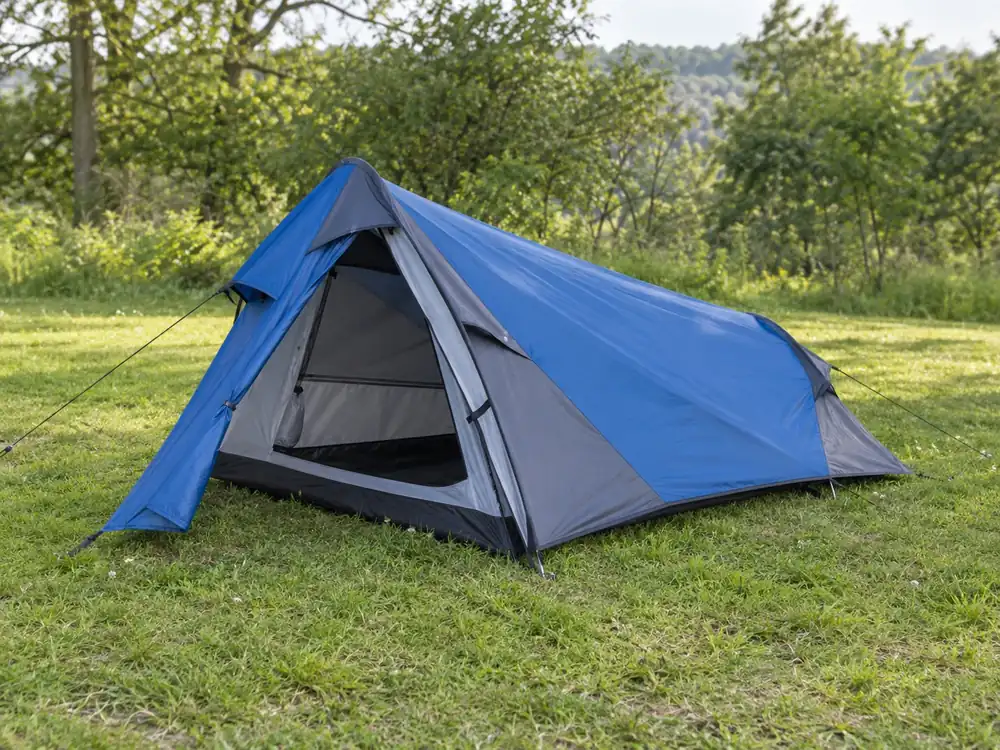
High Peak Minilite tent
Cheapest
|
Price | See price |

OneTigris Tangram UL double tent
Our favourite
|
Weight | See price |
Which tent should you buy? The 2 best of 2026 on Amazon
Cheapest 1. High Peak Minilite tent
The good
Price: what we like most about this tent is the price for the quality you get.
Weight: perfect for carrying (under a kilo).
Size: we like how compact it is.
Strength: it stands up to rain very well.
Worth knowing
Condensation: lots of condensation, as it’s single-skin.
Our review of the High Peak Minilite tent
This ridge tent is designed to be easy to carry and for one person. It’s perfect to take on a route or for an overnight stop, as it’s so compact and light. As for value for money, it’s pretty good, since it costs very little.
Our one complaint is the condensation that builds up inside, as it’s single-skin.
I carry it as my ‘just in case’ tent on cycling tours.
It’s small and light, easy to pitch, and much cheaper than the other ultralight tents I’d looked at.
I’ve slept in it during an incredible storm in the Alps and not a drop of water got in. I’ve taken it up the Stelvio, the Falzarego, the Gardena Pass… I’d have hated climbing with an extra kilo of tent.
On the downside: it condenses A LOT, though in summer that doesn’t matter much. It’s small, and spending a long time inside (say, if you’re stuck in it on a bad day) feels a bit cramped. With a bit of experience, propping things (trainers or flip-flops) against the middle of the sides from inside makes the space quite a bit bigger. I’d add guy lines to the middle of each side to pull the walls out, which would make it much more comfortable.
Our favourite 2. OneTigris Tangram UL double tent
The good
Weight: under 2 kg.
Materials: made of nylon.
Versatile: we love the number of shapes and set-ups this tent allows.
Service: the customer service is outstanding.
Occupancy: perfect for two people.
Seasons: perfect for 3 seasons.
Worth knowing
Price: we find it a bit expensive.
Our review of the OneTigris Tangram UL tent
We love this multi-purpose tent. It’s ideal for carrying thanks to its low weight and how compact it is when packed. It’s a great size for two people, and even better for one given how roomy it is.
It isn’t a ridge tent as such, but we include it here because it’s the closest thing to one.
What we like most is how many shapes it offers: you can arrange the fabric however you like, from a simple porch to a set-up with the sides raised.
Bought it and tested it on a ‘conflict zone evasion’ course with JJ-Supervivencia.
The shelter is very easy to pitch, very practical, light… Simply a perfect product for my needs, light enough for my rucksack and 100% reliable.
The after-sales service from the seller, OneTigris, is among the best I’ve seen: they dealt with my query instantly, very professionally and graciously.
With that attitude they’ve won a loyal customer.
Ease of pitching: extremely easy, even for beginners.
Finish: perfect, built for rough handling in the field.
Living space: two people comfortably with their gear inside, fully protected.
Recommended: yes.
What to look for when buying a ridge tent
If you’re looking for a ridge tent, as we explained above, you see fewer of them these days because other tents, such as domes, have better designs. They’re quite heavy compared with modern tents and, because of their shape, there isn’t much room inside: only in the middle, and the central pole restricts movement.
We’ve shown you the two best ridge tents on the market, or at least the best for our readers and us. Even so, here are some tips for choosing one in case you want to look at others.
You’ll have noticed we’re not huge fans of this type of tent and always recommend other types for their improved features, but if you still want one, read on.
Price
As always, this depends on what you want to spend. The downside of these tents is that they’re quite expensive. There are exceptions, like the High Peak Minilite shown above, but generally you’ll find them from €90 upwards.
Space
This is one of the main things to consider: before choosing a model, be sure how many people will use the tent, then add one more so you have some room for luggage.
As you know, because of its shape a ridge tent has no room at the sides, but there are tricks to gain some, such as propping rucksacks against the walls to lift the canvas a little.
Materials
Fabrics should be highly durable, such as treated cotton, polyester or nylon. Poles should always be fibre and pegs steel (there are always exceptions, but that’s our recommendation). Always make sure they’re good quality and that the material suits what you need; reading the manufacturer’s specifications helps you know how many seasons the tent is for and, above all, whether it’s waterproof and windproof.
Openings
Openings, meaning windows and doors, are another important factor. You’ll have noticed that tents usually have side openings or even a second door as well as the main entrance. This matters: the more openings, the better you can control the temperature inside, and the better the tent. That’s why these tents are more likely to suffer condensation than others. Often, though, it depends on the manufacturer, who will only include the openings the tent strictly needs.
Ridge tents don’t usually have side openings, but always make sure yours has a good mosquito net.
Frequently asked questions
It’s an A-shaped tent (A-frame) with a lengthwise ridge pole and two upright poles at the ends. It’s the classic scouting and bushcraft design.
A ridge tent prioritises simplicity and ventilation, with sloping walls and a pitched roof. Modern domes and tunnels are usually freestanding, roomier for the same weight and offer better wind resistance with fewer pegs.
Canvas (cotton/polycotton): very breathable and comfortable in the heat; heavier, and needs drying fully and maintenance (reproofing over the years).
Polyester: lighter and low-maintenance, dries quickly; less pleasant in the heat and can suffer more condensation.
Yes, if they meet the minimums: in polyester, look for a flysheet HH ≥ 2,000–3,000 mm and groundsheet ≥ 3,000–5,000 mm with taped seams. Canvas should come treated (water, mould, UV) and needs its fibres to “weather in” after the first few soakings and dryings.
Very well if they have high vents, mosquito mesh on the doors and walls that let air flow. The pitched shape helps warm air rise and escape at the top.
Reasonably, if they’re well tensioned and anchored. However, for the same weight, a modern dome or tunnel with crossed poles usually does better in wind. Use quality pegs and reinforce the guy lines.
Canvas ones are heavy and not ideal for trekking; they suit car camping or fixed camps better. In polyester there are lighter models, but they’re still less efficient than a light dome on the trail.
Yes, pitching is simple: end poles, ridge pole, tensioning and pegs. With practice, 10–15 min.
As a rule, they’re 3-season tents. In a mild winter they can do the job if you add a footprint and good insulation and manage ventilation. For snow or strong wind, a dedicated 4-season tent is better.
Only if the model has a stove jack (fireproof flue outlet) and proper ventilation. Use heat protection and a CO detector. In polyester, it’s not recommended.
For 2 people in comfort: inside ≥ 120–140 cm wide and 210–230 cm long; for 4 people, look for 2 “bedrooms” or a large ridge tent with a porch for gear.
A footprint, better pegs, reflective guy lines, seam sealer (if needed), a windbreak for cooking (always outside) and an inside organiser.
Dry completely before storing, clean with mild soap, never store it damp, and reproof canvas when water stops beading. Avoid long exposure to UV.
Other types of tent you may like
 Best luxury tents
 Best Large Camping Tents of 2026
 Best cheap tents of 2026
 Best camping tents
 Best family tents of 2026
 Best tents for kids
 Best dome tents of 2026
 Best tipi tents
 Best 2 Seconds pop-up tents
 Best tunnel tents
 Best camping gazebos
 Best inflatable tents
We choose products independently. If you buy through our links, Amazon pays us a small commission at no extra cost to you.